

4 Maia Prompts Every Portfolio Ops Team Should Be Running
Every PE firm we speak with has a backlog of analysis and tasks that *should* happen every month and quarter but rarely, or only sometimes, do. The partner-ready portfolio brief, the plan-versus-actual variance run across every company in the fund, the check that flags a stalled initiative before it shows up in the numbers. Sound familiar? Each one is too small to staff a person against, but far too important to keep skipping or scrambling to compile.
Maia, our native AI layer, changes the math on these. Because Maia sits on top of Maestro; mapped KPIs, operating plans, value-creation levers, initiatives, financials and company updates – these prompts run against a clean Context Layer, so answers always reflect your actual portfolio and live metrics. With the data problem solved, the only question left is what to ask.
Here are four prompts clients are already running and seeing immediate impact from…
Portfolio impact and value realization
A full portfolio review is the thing every firm means to do each quarter— pulling goals, KPIs, and operating-plan targets for every company in a fund, then comparing actuals against plan and prior year across income statement, bookings, and pipeline.
With Maia, that’s one prompt against your live Maestro data. It retrieves every company in the fund or vintage, captures the three dimensions that matter (current-year actual, operating plan, prior year), runs the variance analysis, and hands back a structured, CIO-ready synthesis — leading with what’s off-plan and what action it warrants, not a recap of what’s happening or working.
A week of assembly becomes a first draft in minutes, and your time goes to judgment instead of data gathering.
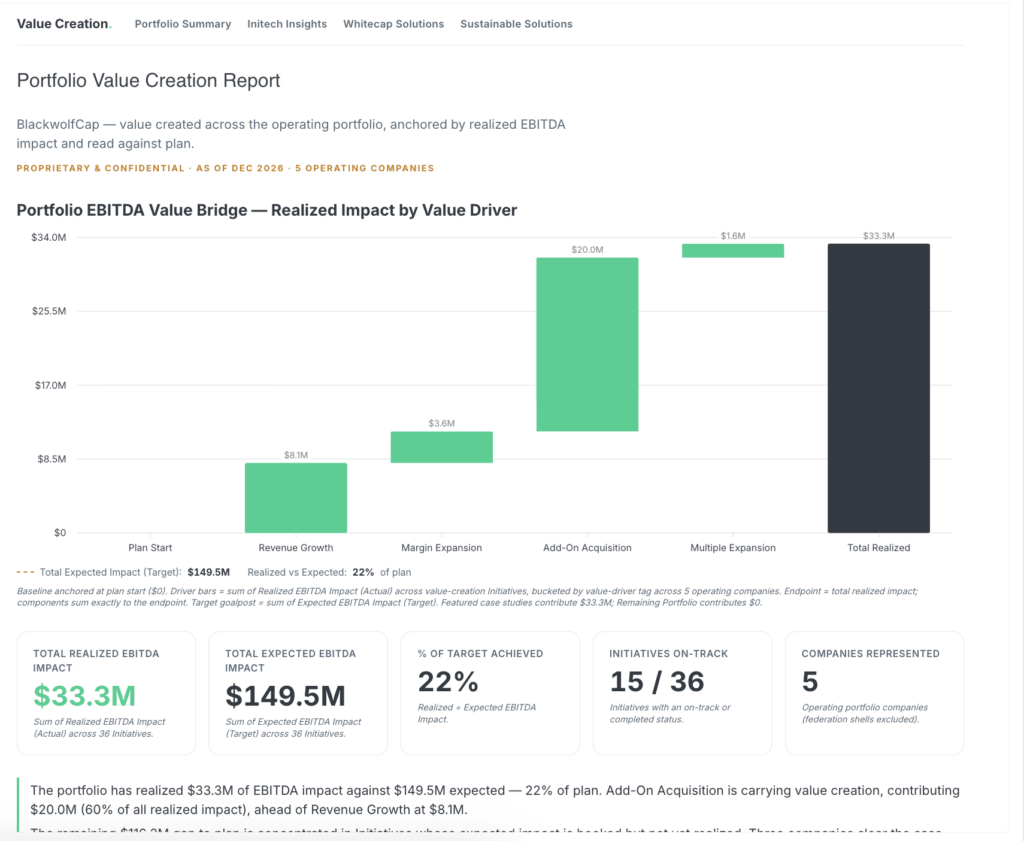
Maia returns a plan-vs-actual review across the Northbridge Fund IV portfolio in seconds:
A CIO-level synthesis leading with variances: an executive summary, a company-by-company breakdown with material variances flagged, portfolio-wide themes, and the companies needing immediate attention. Direct Maia to run this the prompt 1st of every month, send the summary and a notification to key stakeholders to review.
Bookings and pipeline heath
Revenue is a lagging indicator; bookings and pipeline are where the story is actually being written. A company can look fine on the income statement while its renewal mix erodes or its pipeline thins out beneath the targets it needs to hit.
This prompt has Maia assess bookings momentum and pipeline coverage across the portfolio, including pulling data from Salesforce — new-versus-renewal mix, total contract value trends, and whether the current pipeline is sufficient to support the next period’s bookings and revenue targets.
It’s the early-warning system for companies that are about to miss before the miss shows up in the financials…
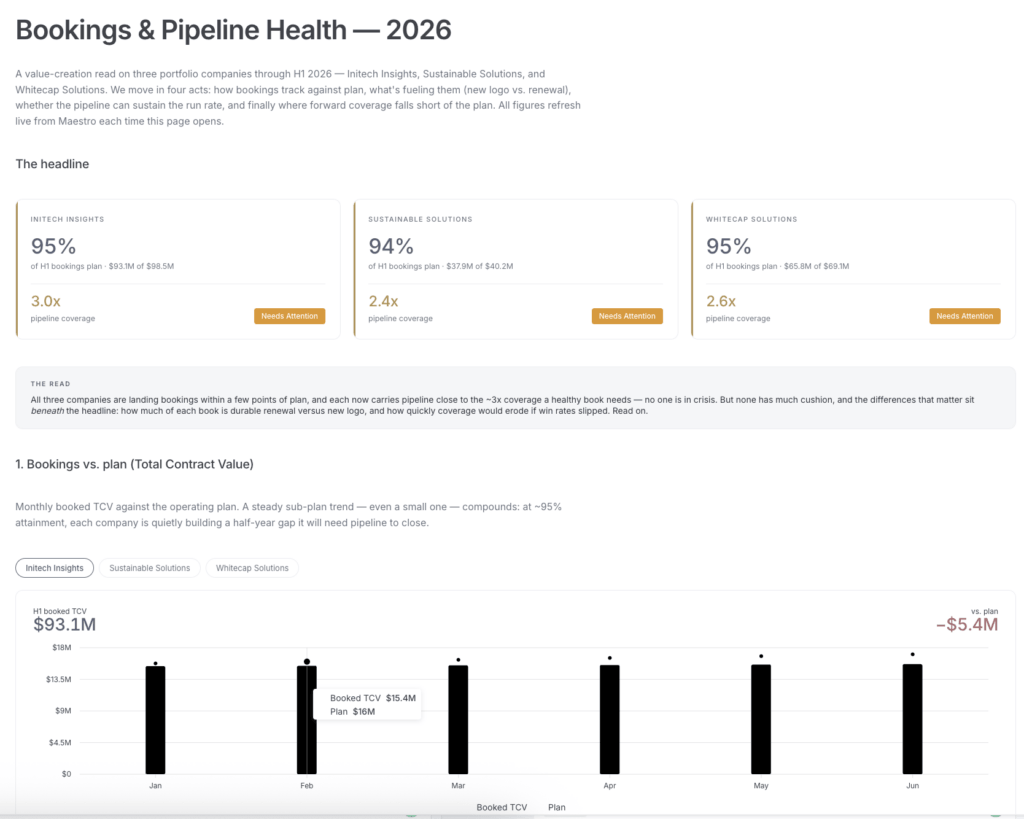
Maia assessing bookings momentum and pipeline coverage across the fund:
New-vs-renewal mix and its trend, TCV against plan, and coverage ratio against each company’s bookings target. Then flags every company whose pipeline can’t support its 2026 plan, ranked by the size of the shortfall. The early-warning system for a miss before it reaches the financials.
Beats and misses, ranked.
Whether by design or otherwise, most firms collect PortCo data in multiple formats and cadences, and then review beats and misses manually, company by company — which means it often happens late, unevenly, or not at all. This prompt asks Maia to compare actuals against plan across the portfolio and surface *only* the largest variances in either direction, ranked by magnitude.
The result is a triage list: the companies meaningfully ahead of plan that might warrant leaning in, and the ones falling behind that need a conversation.
Run it every quarter and the same prompt starts revealing forecasting patterns — which companies are off-plan, and in which direction…
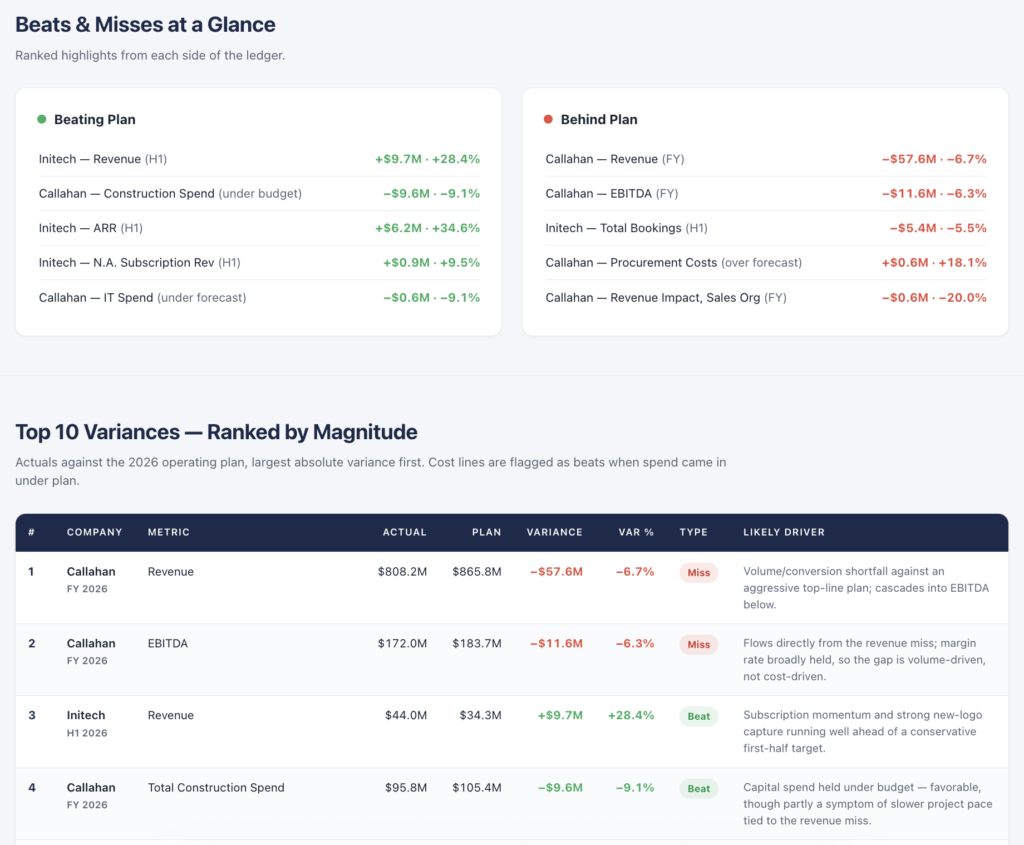
Maia compares 2026 actuals against operating plan across the fund and surfaces the largest variances by magnitude:
Beats separated from misses, each ranked, with the metric, company, absolute and percentage variance, and a one-line note on the likely driver for further diagnosis. Run quarterly, the same prompt starts revealing which companies are off-plan and in which direction.
Board pre-read
Before a board meeting, everyone wants the same context: the latest metrics, what’s changed since last quarter, where the company sits against the plan, the status of the initiatives that were supposed to be moving, and a few sharp questions worth raising.
Assembling that by hand means digging through prior decks, notes, and spreadsheets. Maia builds the pre-read from your Maestro data in one pass — most recent financials, deltas from the prior period, plan performance, active value-creation levers and their status, and a draft set of focused questions for the meeting.
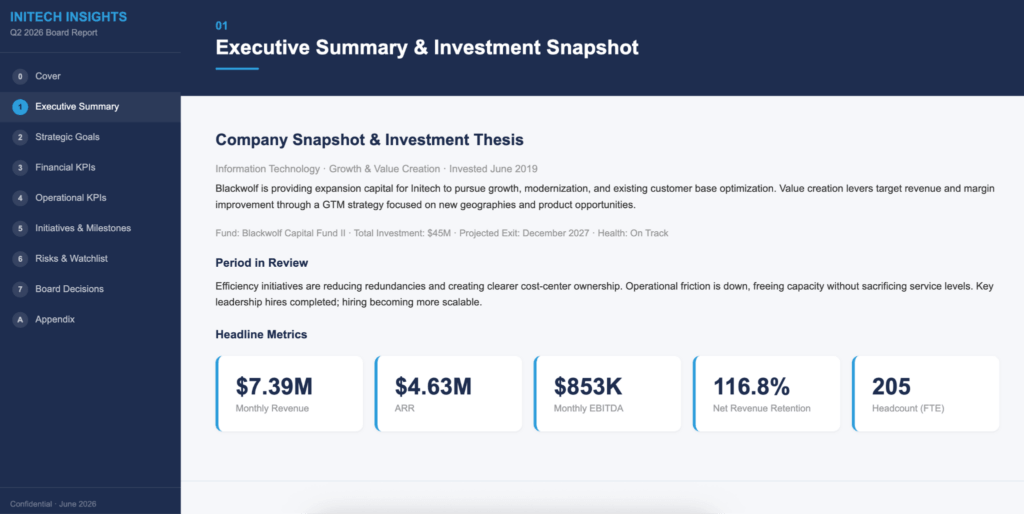
Maia assembles the board pre-read for Meridian SaaS in one pass:
the latest metrics and changes since last quarter, actuals against plan with material gaps flagged, the active value-creation levers and their status (including a stalled pricing lever), and 5 focused questions drafted from what’s off-plan or stalled. The board conversation gets sharper, and the prep hours go back on your calendar.
Getting Started
That’s just the tip of the iceberg of what Maia and Maestro can do.
The best place to start often isn’t the most ambitious prompt, but the one your team already wishes existed; the review everyone dreads assembling or the analysis that always happens too late. Pick that one, run it against your live data, and refine from there.
The first in a series exploring Maia use-cases. Coming soon: the most useful Maia prompts for PortCo management teams, plus a deep dive on quarterly board prep. Want a walkthrough of Maia against your own portfolio? Reach our to the team on hello@go-maestro.com