

Why Some PE Operating Teams Consistently Outperform — The Common DNA Behind It
The average operating team has more than doubled in size over the past four years.
Yet another data point proving that firms have decided operations is where returns are now won. What it doesn’t tell us is why some of those teams produce repeatable results and others never scale their impact beyond the deal in front of them. The gap between those two outcomes is widening. And it doesn’t map to the thing most assume it maps to.
The mandate has never been more critical
The stakes behind that shift are easy to quantify. The majority of value creation today comes from operational improvement rather than financial engineering. Revenue growth accounted for 71% of the value created in 2024 exits, up from 64% the year before.¹ And LPs have clocked it: 53% now rank a GP’s value creation strategy among their top five criteria for choosing a manager, ahead of sector expertise.²
Which raises the question a lot of firms are still trying to answer by instinct: what does a genuinely high-performing operating team actually look like?
From across our global client base and discussions with dozens of leading teams and operators, across strategies, scale and markets, a clear pattern has emerged…
Structure gets most of the attention. It’s the wrong place to look.
Ask ten firms about the make-up of their operating team and you’ll get ten different answers. Some are intentionally lean, others build deep functional benches. Many have evolved into hybrid or fully embedded models, with operators sitting alongside deal teams and portfolio-company management.
Over the past two decades we’ve seen these resolve into three recognizable archetypes. Each reflects a different approach to delivering value creation: Enablement Ops, Active Ops and Institutional Ops.
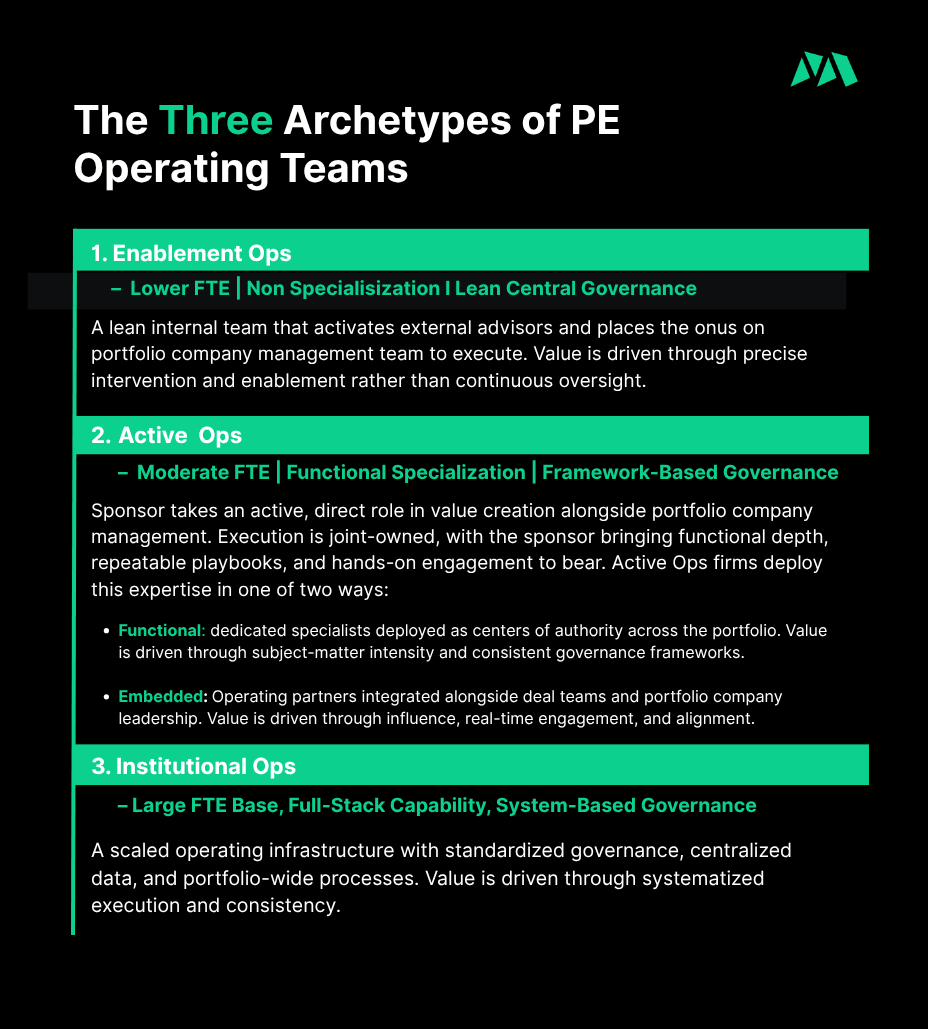
It’s tempting to treat the choice between them as the important question. Which headcount, which reporting line, which degree of embeddedness produces the strongest returns?
The honest answer, borne out again and again across the leading firms we work with, is that no single archetype has a monopoly on outperformance.
Lean teams outperform. Deeply embedded teams outperform. Institutional platforms outperform. And within every one of those structures, teams built almost identically fall short. There is no single “right” model — but there is a recognizable DNA.
The Common DNA of high-performing Operation Teams
Despite differences in structure, scale, and strategy, high-performing operators share a common set of traits. We see six consistently:
- Clarity of Mandate. They’re explicit about where they own outcomes and how they partner with deal teams and management, from diligence through exit.
- Collaboration & Transparency. Information flows are intentional rather than accidental, with shared visibility across deal teams, operators, and portfolio management.
- Data-Driven Discipline. Structured data sharpens judgment instead of replacing it, moving teams from intuition-driven intervention toward insight-driven execution.
- Scalable Processes. Repeatable playbooks and institutionalized governance let value creation scale beyond individual deals or individual operators.
- Adaptability. Resources get reallocated and initiatives resequenced quickly, without losing momentum when conditions shift.
No firm exhibits all of these traits in equal measure, and no single trait is sufficient on its own. Instead, high-performing teams demonstrate two or more traits working together – aligned to their archetype and investment strategy.
These traits, rather than the org chart, are what predict repeatable operational alpha. A lean enablement team and a large institutional platform will express them very differently; trade-offs are real, intentional, and strategy-driven.
So the question every operating leader should be asking is whether the right traits run through the model they already have.
Which combination is yours?
Which traits reinforce one another across which strategies and archetypes, what do winning combinations look like in practice, how leading firms have actually embedded them, and what changes when AI enters the operating model? That’s what the rest of this series digs into, and what the full research lays out in detail.
The full DNA whitepaper — the winning combinations, real-world case studies, and how leading firms embed these traits into their operating rhythms, technology, and processes across every archetype — is releasing soon. Reach our to the team on hello@go-maestro.com to learn more.
¹ Source: Bain & Company, Global Private Equity Report 2026 (February 2026).
² Based on the McKinsey & Company LP Survey (n=300), January 2026, as detailed in the Global Private Markets Report 2026 (February 10, 2026).